%25202-127x128.png&w=256&q=75)
Industry Trends
Why Indian Game Studios Still Build Alone: The Missing Layer of Collaboration and Publishing
We think a lack of collaboration is one of the things holding Indian game development back., but they are programmes run by a few large organisations, and we could not find evidence of a broad peer network between small studios. The evidence below is mostly indirect, because nobody measures collaboration directly, so treat our conclusion as an informed opinion and not a statistic.
The publisher layer is thin
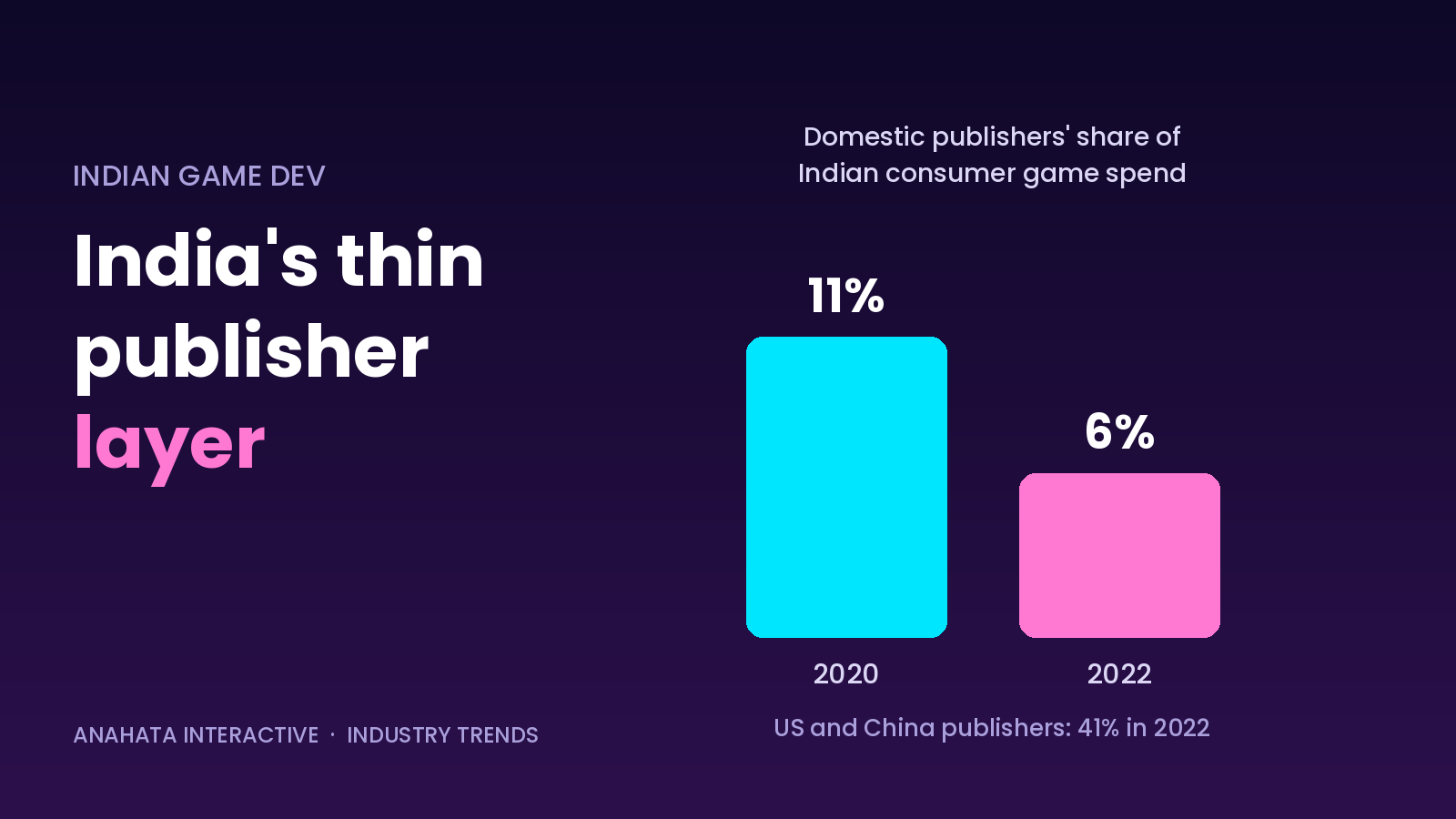
A 2024 study by Eximius Ventures, using 2022 data, found that only 6% of Indian consumer game spending went to domestic publishers, down from 11% in 2020. Publishers based in the US and China together took 41%. The authors argue that India lacks publishers with real genre expertise, especially in mid-core games, which pushes developers towards simple hypercasual and casual titles. The figures are older and come from the authors' own use of third-party data, so check them before quoting, but the direction matches what small studios describe.
Trusted to co-develop, rarely trusted to lead
A June 2025 Business Standard report notes that Indian studios have long been trusted as co-development partners but rarely given lead roles, funding or backing for large live-service games. It also cites Tracxn data showing equity funding for Indian gaming companies at $20.2 million in the first half of 2025, down 38% from the same period of 2024. Less money and fewer lead roles mean fewer chances to build the shared relationships that collaboration depends on.
Where collaboration is starting
There are real efforts. Nazara's publishing division, announced in December 2023, partnered with four Indian studios and aimed to invest INR 1 to 3 crore per game, with help on user acquisition and live operations. KRAFTON India's incubator, KIGI, offers financial assistance, mentorship and access to global platforms, and every Indian indie title shown at The Mobile Premiere on 28 October in Bangkok receives INR 1 lakh. At the community level, the founders of Indofuturism Studios and Dasein Lab ran a worldbuilding hackathon in Kolkata in March 2026, with 36 participants in mixed-discipline teams. These are good signs, but they are programmes run by a few large organisations, and we could not find evidence of a broad peer network between small studios.but much of it appears to work in isolation.
What small studios can do without waiting
None of this needs a publisher's budget. Swap playtesting with another studio, because fresh eyes catch onboarding problems in an hour. Cross-promote each other's games where store policies allow it. Share tooling, plugins and lessons about store reviews and monetisation. Run or join a game jam with people from other disciplines. Agree revenue shares with freelance artists and composers, so they have a stake in the result. And if you pitch publishers, ask for clear terms on splits, who owns the IP, and what support you actually get.
Our view
India has a large audience and growing talent, but much of it appears to work in isolation. We would like to see more studio-to-studio swaps, more co-publishing between small teams, and more public sharing of results, including failures. If you run a small studio and want to swap playtests or compare notes, we would be glad to hear from you.
Sources: Eximius Echo, The Need for Game Publisher Ecosystem in India; Business Standard on Indian studios and homegrown IP; Inc42 on Nazara's publishing division; Inven Global on KRAFTON India and The Mobile Premiere; Outlook Respawn on Indofuturism.